Mar 242010
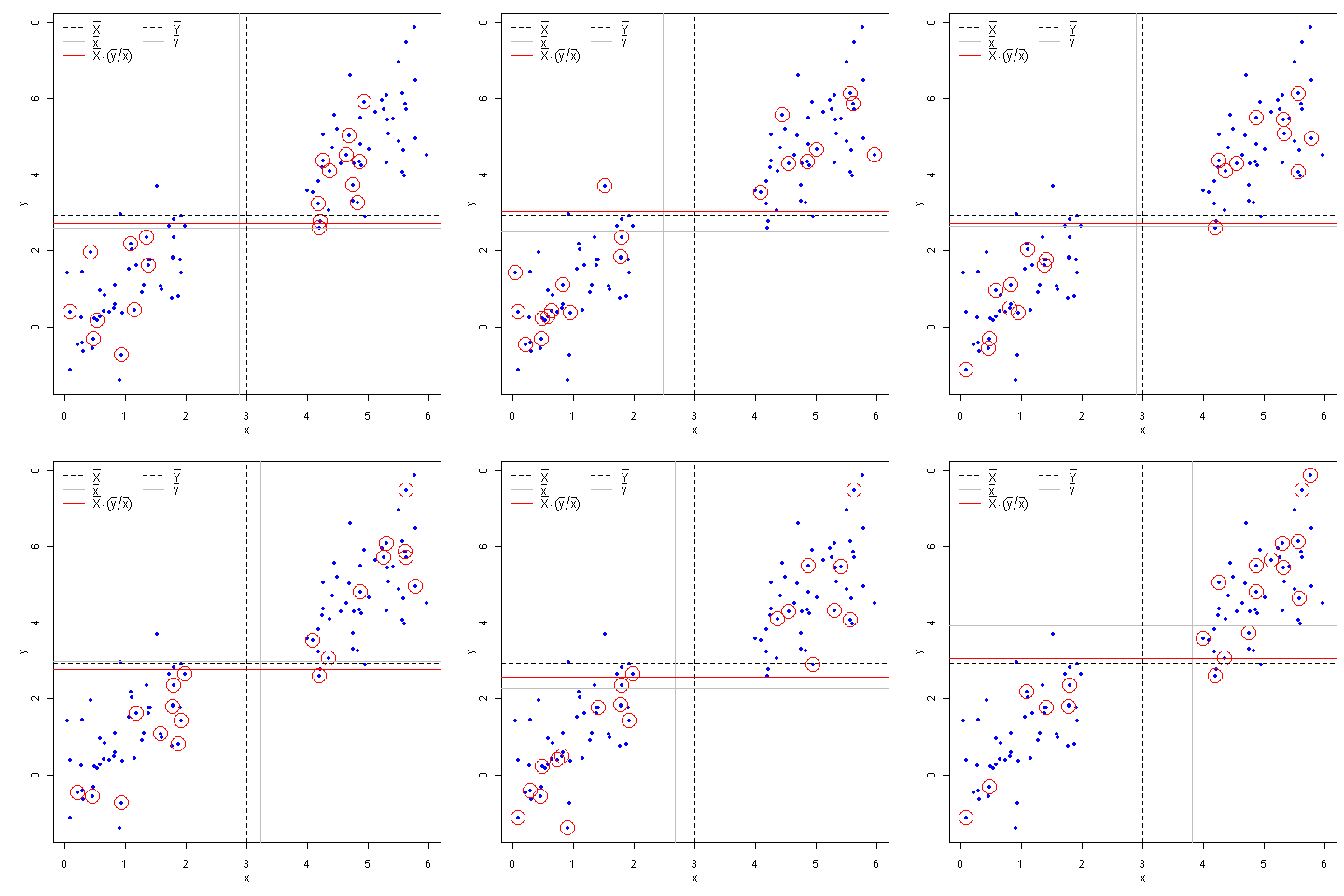
Amber Watkins gave me a suggestion on the animation for the ratio estimation, and I think this is a good topic for my animation package. I’ve finished writing the initial version of the function sample.ratio() for this package, which will appear in the version 1.1-2 a couple of days later.
As we know, the benefit of ratio estimation is that sampling skewness may be adjusted for, because the estimation of will make use of the information in the relationship of X and Y:
. Here is a demo (we can see the ratio estimate, denoted by the red line, generally performs better than
):
And here is the code:
## To appear in animation 1.1-2: see documentation there
sample.ratio = function(x = runif(50, 0, 5), R = 1,
y = R * x + rnorm(x), size = length(x)/2, p.col = c("blue",
"red"), p.cex = c(1, 3), p.pch = c(20, 21), m.col = c("black",
"gray"), legend.loc = "topleft", ...) {
nmax = ani.options("nmax")
interval = ani.options("interval")
N = length(x)
for (i in 1:nmax) {
idx = sample(N, size)
plot(x, y, col = p.col[1], pch = p.pch[1], cex = p.cex[1],
...)
points(x[idx], y[idx], col = p.col[2], pch = p.pch[2],
cex = p.cex[2])
abline(v = c(mean(x), mean(x[idx])), h = c(mean(y), mean(y[idx])),
col = m.col, lty = c(2, 1))
abline(h = mean(x) * mean(y[idx])/mean(x[idx]), col = p.col[2])
legend(legend.loc, expression(bar(X), bar(x), bar(X) %.%
(bar(y)/bar(x)), bar(Y), bar(y)), lty = c(2, 1, 1,
2, 1), col = c(m.col[c(1, 2)], p.col[2], m.col[c(1,
2)]), bty = "n", ncol = 2)
Sys.sleep(interval)
}
}
library(animation)
sample.ratio()
## Save as an HTML page
ani.start()
sample.ratio(c(runif(50, 0, 2), runif(50, 4, 6)), size = 20)
ani.stop()
## Reproduce the above GIF animation
saveMovie({
set.seed(123)
sample.ratio(c(runif(50, 0, 2), runif(50, 4, 6)), size = 20)
}, moviename = "ratio-estimation", para = list(mar = c(4, 4,
1, 0.5), mgp = c(2, 1, 0)))

Recent Comments